

How OKRs supercharge agile teams and processes
OKRs (Objectives and Key Results) give agile teams what most sprints lack: a clear reason to care about what gets built next. This post explains what OKRs are, why they pair naturally with agile, and three specific ways they sharpen how teams work, prioritize, and measure success: setting a clear mission, building team autonomy, and defining measurable outcomes for features and user stories.

OKRs give agile teams something most sprints lack: a clear reason to care about what gets built next.
This post covers what OKRs are, why they pair naturally with agile, and three ways they can sharpen how your team works, prioritizes, and measures success.
What are OKRs?
OKRs stands for Objectives and Key Results. The framework is a practical, straightforward way to define and measure goals, both ambitiously and quantifiably.
Objectives are qualitative, motivating goals that push a team forward. They describe what a group wants to accomplish in a given period.
Key Results (KRs) are measurable outcomes that define what achieving the objective actually looks like. They share the attributes of SMART goals, but with a more ambitious target in mind.
You can write any OKR using this template:
"We will achieve [objective] as measured by 1) [KR1], 2) [KR2], and 3) [KR3]."
To understand how OKRs relate to KPIs, read this blog post.
What's missing in agile, and why OKRs help
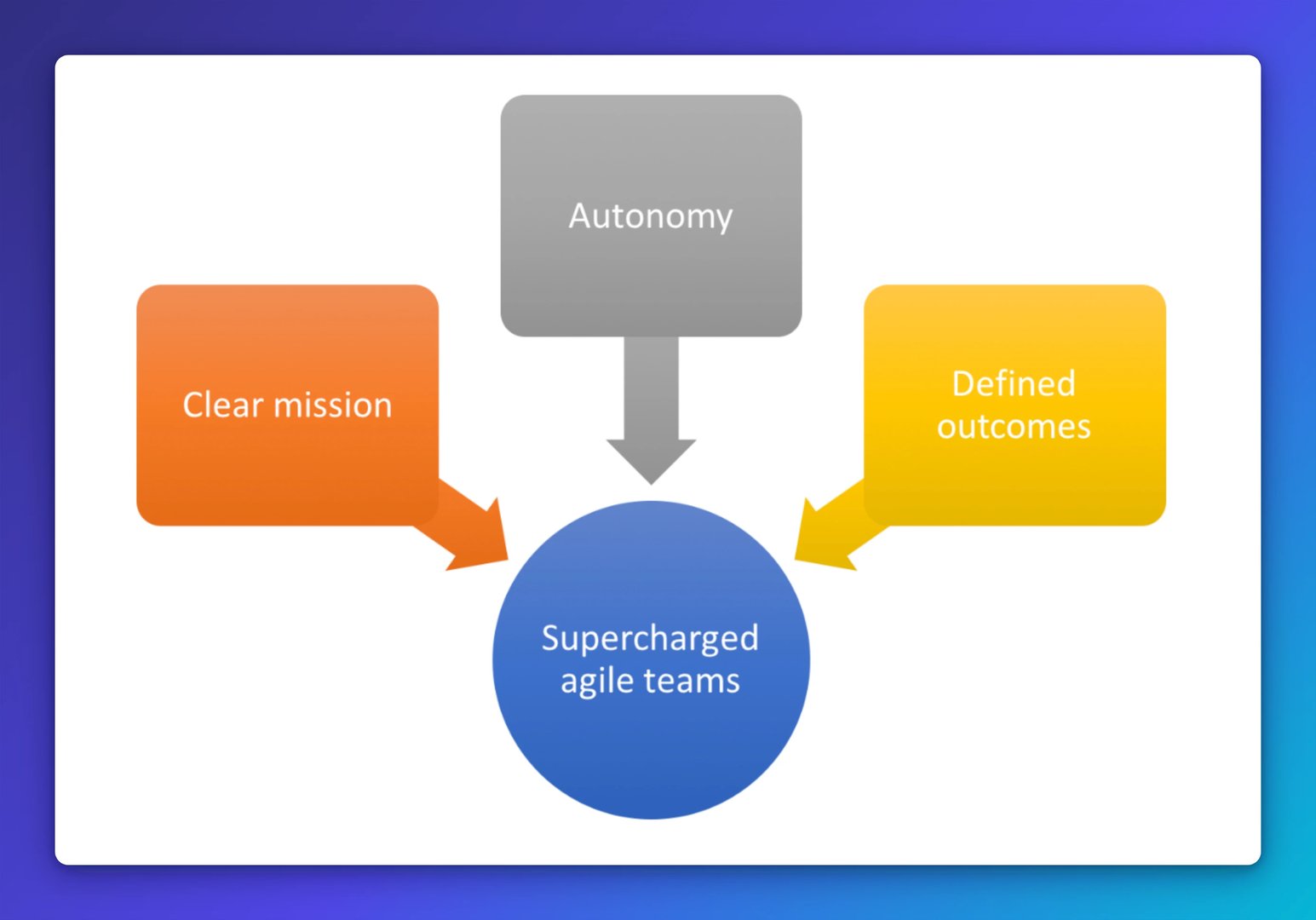
OKRs improve agile processes in three specific ways:
Setting a clear objective for the team
Creating autonomous teams that own their outcomes
Defining measurable outcomes for features and user stories
Agile frameworks are good at helping teams move through defined work in an organized way. They surface bottlenecks, clarify what's in progress, and improve throughput.
What they don't provide is a method for deciding what to work on next. That question usually falls to a fuzzy, often political process between product owners, scrum masters, and leadership. The result: teams spread thin, priorities debated without a shared reference point, and effort moving in directions that don't add up to much.
Clear mission
OKRs fill that gap. They make goal-setting structured and consistent across groups, so every team pulls toward the same outcome. The practical effect is focus: fewer things, done better.
Here's an objective we defined for our DevOps team one quarter:
We will achieve higher operational availability and lower operational costs.
At this stage, leadership works with the team to shape the objective and give it direction, then steps back. The team decides how to achieve it and, often, how to measure it. That's where the Key Results come in.
Autonomy
When teams help define how success is measured, they take ownership of the result. That's why the OKR framework recommends a collaborative approach to setting KRs.
In the DevOps example, the team worked with leadership to complete the template:
We will achieve higher operational availability and lower operational costs as measured by:
Zero DevOps-owned services in Rackspace (move everything to AWS)
XX% reduction in AWS operational cost
Zero single points of failure
With alignment on OKRs like these, leadership doesn't need to prescribe user stories or dictate prioritization. Instead, they check in regularly to see how the team is tracking against their KRs. We mapped this check-in to our sprint pre-planning meeting, so it fits the existing agile rhythm without adding new calendar overhead.
In those pre-planning sessions, leadership reviews progress and asks whether the team is moving the needle. If they're off track, the meeting shifts into a brainstorming session to course-correct. No micromanagement, just a shared view of what matters.
This is the only way to scale a team: give people a goal they helped shape, then get out of the way.
Defined outcomes
OKRs work at multiple levels, not just quarterly planning:
Quarterly goals
Large product releases
Individual features and user stories
Agile teams already use Acceptance Criteria (AC) to define when a story is done. AC is measurable immediately after delivery. What it doesn't capture is whether the feature actually moved anything for customers or the business after it shipped.
That gap explains why a high percentage of software features go unused. Teams build something that meets the spec, ship it, and move on, without ever knowing if it worked. And because removing features is uncomfortable, the software accumulates functionality that confuses users and adds no value.
OKRs fix this by treating features as testable hypotheses with expected outcomes.
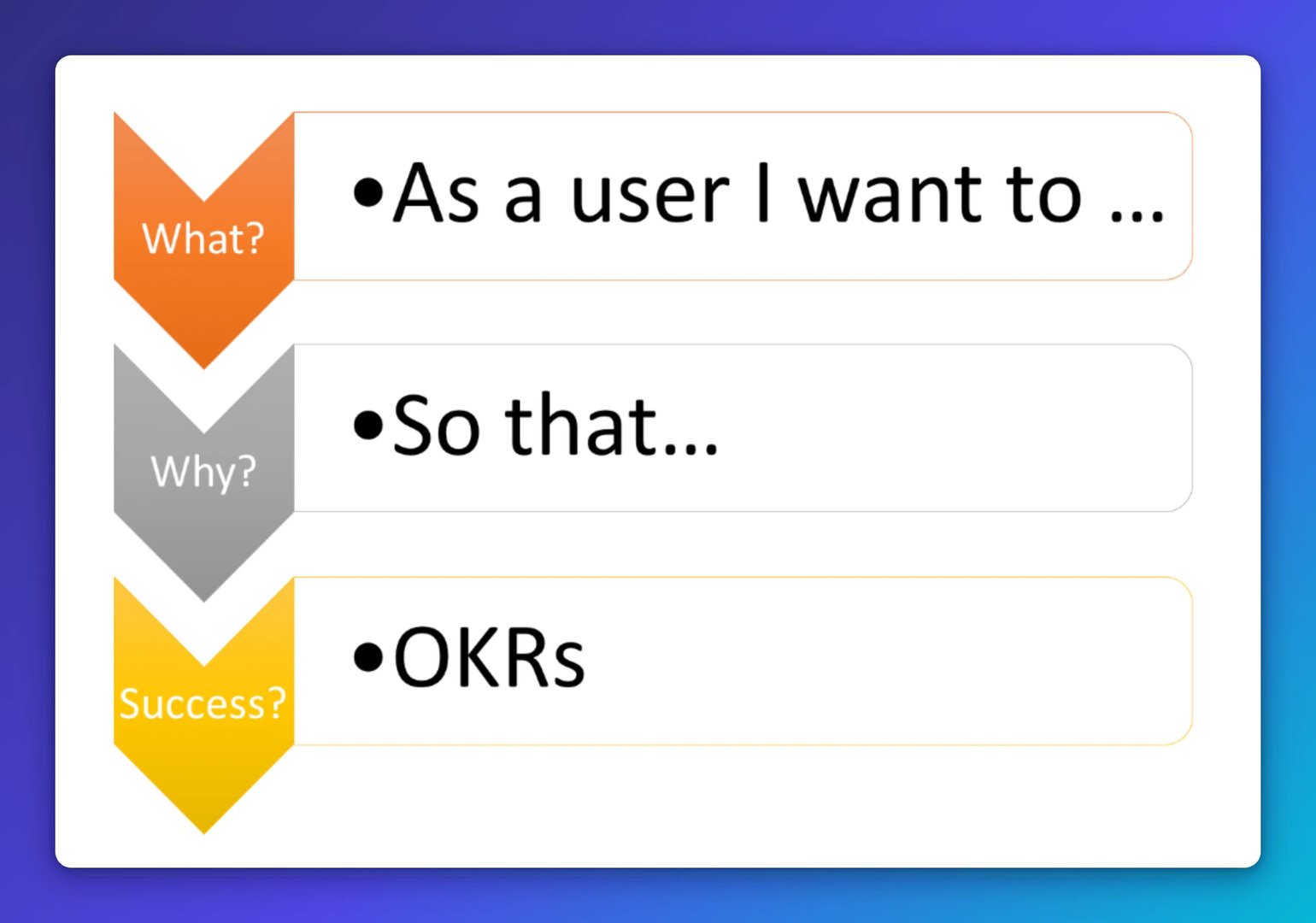
Here's a user story without OKRs:
As a user, I want to share assets easily with team members who haven't signed up yet.
As the product team, we want users to invite new users while sharing content, so we can expand usage within organizations.
That's a solid story. It clarifies the requirement and explains the "so that." But it doesn't tell you whether the feature succeeded once it was in users' hands.
Here's the same story with an OKR added:
We will achieve higher user satisfaction and expansion in new accounts as measured by:
X-point increase in satisfaction survey scores from trial users
Average Y% increase in new users signing up across all accounts
Now the team has a hypothesis to test. If the numbers don't move, you revisit the feature. If they do, you build on it. Either way, you know something real.
Create custom dashboards for you and your team.
Get started with KlipsPutting it together
OKRs were first developed at Intel and later made famous by Google. LinkedIn, and Klipfolio are among the many organizations that have adopted the framework.
For software development teams, the payoff is practical. OKRs give teams a purpose worth working toward, the autonomy to decide how to get there, and a clear way to know whether their work actually mattered.
That's not a new process layer. It's the missing piece that makes agile work the way it was supposed to.
Related reading:
Published 2026-08-22




Most recent
- AUG 11Beyond simple sign-ups: how True Trials and Activation predict growth
- JUL 7Why business leaders miss important trends in their dashboards
- JUN 19The best chart for the job: Visualizing data for non-technical users
- JUN 95 tips to understand (and organize) your restaurant data
- MAY 26Think in Horizons, Not Seconds
- MAY 2010 Cloud BI Dashboard Tools for Small Businesses in 2026