

How (and when) to create a custom metric
Commonly used metrics do the trick most of the time. But no business is completely like another. Custom metrics go beyond the standard and ensure you measure what actually matters to your success, from defining the right audience segment to connecting your metric to a real business goal.

Business metrics come in all shapes and sizes.
Most are familiar: click-through rate, profit, or return on ad spend. But sometimes a pre-existing metric doesn't tell you what you actually need to know. A custom metric fills that gap, giving you a precise measurement without compromising accuracy.
This post covers what custom metrics are, when to use them, and how to build one that works for your business.
What is a metric?
A metric is a quantifiable measure used to track and assess the status of a specific process.
We use business metrics constantly, but rarely pause to ask what they actually are. Klipfolio defines it as follows: a metric is a quantifiable measure used to track and assess the status of a specific process.
Some metrics are simple counts: the number of times users visited your website. Others combine two or more measurements into one. Average pages per user, for example, divides total unique page visits by total users.
You can also add, subtract, and divide to express a number as a percentage. Retention rate works this way:
(Employees at start of period - employees who departed) / Employees at start of period
If you started with 100 employees and 2 left:
(100 - 2) / 100 = 0.98 = 98% retention rate
That single number tells you something meaningful: 98% of your team stayed. The arithmetic is simple; the business signal is clear.
What is a custom metric?
A custom metric is a metric you design to measure a specific area of interest that standard metrics don't cover.
You can build one by:
- Counting the number of times something specific happens
- Dividing one metric into another to create a ratio
- Subtracting and dividing to express a result as a percentage
- Combining data points into a table to add context
What makes a metric "custom" is its use. If you developed it yourself to answer a question no standard metric addresses, it's a custom metric, even if it's built from existing measurements.
Why create a custom metric?
Standard metrics exist because they work across many businesses. Churn rate matters to most SaaS companies. Retention rate matters to human resources (HR) professionals. These shared benchmarks let you compare performance across companies and industries.
But no two businesses are identical. The metrics that dominate your industry won't always capture what drives your success, especially when you're using key performance indicators (KPIs) or objectives and key results (OKRs) to set goals.
Consider click-through rate. It's useful for digital advertisers because it normalizes performance across campaigns with different budgets and tells you how many people clicked after seeing your ad. But it doesn't tell you whether the right people clicked, or what they did after they arrived.
A custom metric might measure how many women aged 35 (your target demographic) clicked through to your landing page and then signed up for a free trial, divided by the total number of people who saw your ad. That gives you a precise read on whether you're reaching the audience that matters and whether they're taking the action you want.
That's the real advantage: a custom metric answers the question your business is actually asking, not a generic approximation of it.
When does a custom metric make sense?
Standard metrics handle most monitoring needs. But there are clear situations where a custom metric earns its place.
When current metrics leave gaps
Every metric is a partial snapshot. Cost per click tells you how far your ad budget goes, but not whether you're reaching the right people or generating the right volume. If you're making decisions based on an incomplete picture, a custom metric can fill in what's missing.
When you're running a special project
Standard metrics work well for business as usual. A one-off campaign or a brand-new initiative often needs its own measurement. A custom metric built for that project gives you a signal that's actually relevant to what you're trying to achieve.
When you want a deeper view alongside standard metrics
Custom and standard metrics work well together. Standard metrics give you an overview; custom metrics let you go deeper on what matters most to your specific situation. You don't have to choose one over the other.
Create custom dashboards for you and your team.
Get started with KlipsWhen you work in a specialized or emerging field
Some industries don't have established metrics yet. Account-based marketing (ABM) is a good example. Standard marketing metrics like traffic volume don't serve ABM well, because the goal isn't to reach more people, it's to reach the right ones. That's why metrics like marketing-qualified accounts and reach within an account emerged: practitioners built custom metrics to measure what actually mattered, and those measurements eventually became standard.
If your field is new or specialized, you may need to do the same.
How to create a custom metric
There's no single method. The right approach depends on what you're trying to measure.
Start with a specific audience segment
Many standard metrics treat all users the same. A custom metric lets you focus on a segment that matters to your business.
Maybe you want to know how many male users aged 35 and up, on an iPhone, spend more than 30 seconds on a specific page. You can configure a custom metric in Google Analytics to track exactly that. The result is a number that reflects your audience, not a general population.
Combine the metrics that matter most to you
Click-through rate works because it combines two signals: whether your ad was seen, and whether it prompted action. Think about which metrics, combined, would give you a clearer answer than either one alone.
If you want to know whether subscribers are discovering a key feature, you might divide the number of subscribers who spend at least three minutes on a feature page by the total number of subscribers who visited it. That ratio tells you something useful about feature adoption.
Find a common basis for comparison
When two things are similar but not identical, a raw count comparison misleads you. A campaign with a $100,000 budget will almost always generate more clicks than one with a $1,000 budget, but that doesn't mean it's more effective.
The same logic applies when comparing two subscription products at different price points. Fewer sign-ups for the more expensive product isn't necessarily a failure. A custom metric that normalizes for price or budget gives you a comparison you can actually act on.
How to put your custom metric to work
Building the metric is only half the job. You also need to measure it consistently and connect it to your strategy.
Measure it reliably
Some platforms let you build custom metrics directly into your reporting so they update automatically. In other cases, you'll calculate them manually on a set schedule. Either way, consistency matters: a metric you check irregularly won't give you a reliable signal.
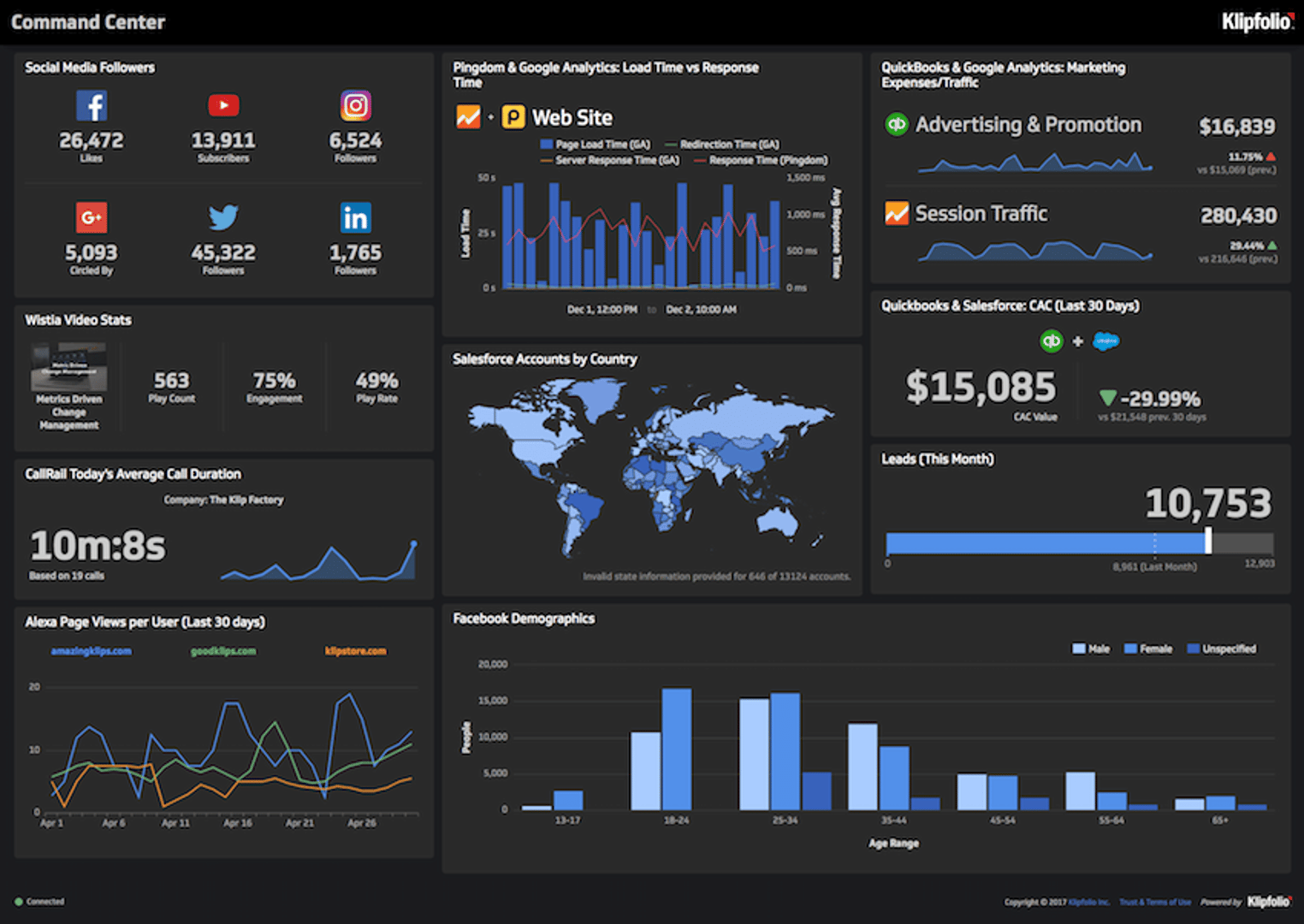
This is where a dashboard earns its value. When your custom metric lives alongside your standard ones in a single view, you stop hunting for numbers and start making decisions. You know the number is right because it pulls from the same source every time, not because someone ran a query this morning.
Connect it to your strategy
If a custom metric genuinely reflects success for your business, treat it like one. Build it into your KPIs or OKRs. Assign it an owner. Set a target. A metric that sits in a spreadsheet without a goal attached is just a number. One that's tied to a decision is a tool.
Create custom dashboards for you and your team.
Get started with KlipsWhen a custom metric is worth the effort
Custom metrics take time to define, validate, and maintain. That investment makes sense when the standard options leave you guessing, when you're running something new, or when your business operates in a way that generic benchmarks don't capture.
If you're pasting numbers into a spreadsheet or asking an AI tool to interpret data it doesn't have context for, a well-defined custom metric solves a different problem: it gives you a reliable, repeatable answer without starting from scratch every time.
Start with the question you actually need answered. Then work backwards to the measurement that answers it.
Published 2026-08-22



Most recent
- AUG 11Beyond simple sign-ups: how True Trials and Activation predict growth
- JUL 7Why business leaders miss important trends in their dashboards
- JUN 19The best chart for the job: Visualizing data for non-technical users
- JUN 95 tips to understand (and organize) your restaurant data
- MAY 26Think in Horizons, Not Seconds
- MAY 2010 Cloud BI Dashboard Tools for Small Businesses in 2026