

Marketing momentum metrics and startup productivity
Momentum metrics measure your team's ability to complete projects and launch campaigns consistently. For early-stage marketing teams, they're often the first thing you can reliably track, and the clearest way to show that the right work is happening before the big results arrive.

Life as a startup marketer is anything but simple. Each day brings new challenges, and the pressure to show results is constant. The smartest marketers guide their decisions with carefully defined metrics and KPIs, but there's one metric most teams overlook: momentum.
Momentum is what keeps a small team moving when the big results haven't arrived yet. It's the proof that the right work is happening, even when the scoreboard hasn't caught up.
What is a momentum metric?
A momentum metric measures your team's ability to complete projects, launch campaigns, and get things done consistently. It's not about vanity numbers or quarterly spikes. It's about throughput: the steady, reliable output that compounds into real results over time.
Growing a business is more meat-and-potatoes than secret sauce. Consistent, unglamorous effort wins more often than big swings. Singles and doubles win the game.
One of the hardest things about working in marketing at an early-stage company is communicating the value of your strategy when results are slow to build. SEO is the clearest example. Ninety percent of clicks happen on Google search, and building that presence is one of the highest-leverage things a startup can do. But it takes time, often years.
I've been at Klipfolio for six years and have been building our SEO strategy since the start. We're only now getting real traction. How do you pitch that to a CEO or CMO reporting to a board that wants results every quarter? With great difficulty.
Momentum is the answer. It's the evidence that the right things are happening every day. Trust is built on momentum. You may not have surged to the top of search rankings overnight, but you did, in a given week, publish three articles and earn an authoritative backlink that will, in time, move the needle.
That's the story you can tell. That's the number you can point to.
Measuring momentum
You're probably already tracking the metrics that matter to the business: traffic, pipeline, conversion rates, revenue. Those are the outcomes. Momentum metrics sit one level upstream. They measure the activity that produces those outcomes.
As a team grows from one person to seven, tracking momentum becomes harder and more important at the same time. Different disciplines, different timelines, different definitions of "done." A web redesign can take months. An email campaign can ship in an afternoon. Comparing them directly tells you nothing useful.
Here are three momentum metrics worth tracking.
Number of tasks completed
Track throughput over time, not against each other. Every member of my team has their own project board in Trello, with a Completed list that shows how much work has shipped. A web designer who closes one large project in a month has accomplished something meaningful. The goal isn't volume for its own sake; it's consistent forward motion.
I also track tasks on a shared team board so everyone can see how their work contributes to the whole. It's not a perfect system, but it gives the team a shared sense of progress and accountability. When the board is moving, confidence follows.
Number of URLs submitted
My SEO instincts demand momentum. Every new post and every updated post gets submitted to Google Search Console as soon as it's ready. I know it can take weeks for a strong piece to rank, but tracking submissions gives an early signal that the pipeline is full.
Of all the momentum metrics I track, this one comes closest to a leading indicator of business results. It requires the content team, the design team, and the web team to all deliver. When the number is healthy, the whole machine is running.
Number of tests deployed
Multi-variant testing, including A/B and split testing, is a core part of conversion rate improvement. It's also a perfect momentum metric.
Every test deployed means a hypothesis being challenged and a question being answered. Does video convert better on the homepage than a static image? The answer matters, and the act of asking it matters too.
Testing has a secondary benefit: it builds team confidence. A lot of marketing teams get stuck in analysis paralysis before launching something bold. Running a test removes the stakes. It reframes "putting yourself out there" as a structured experiment rather than a gamble. A team that tests regularly is a team that moves.
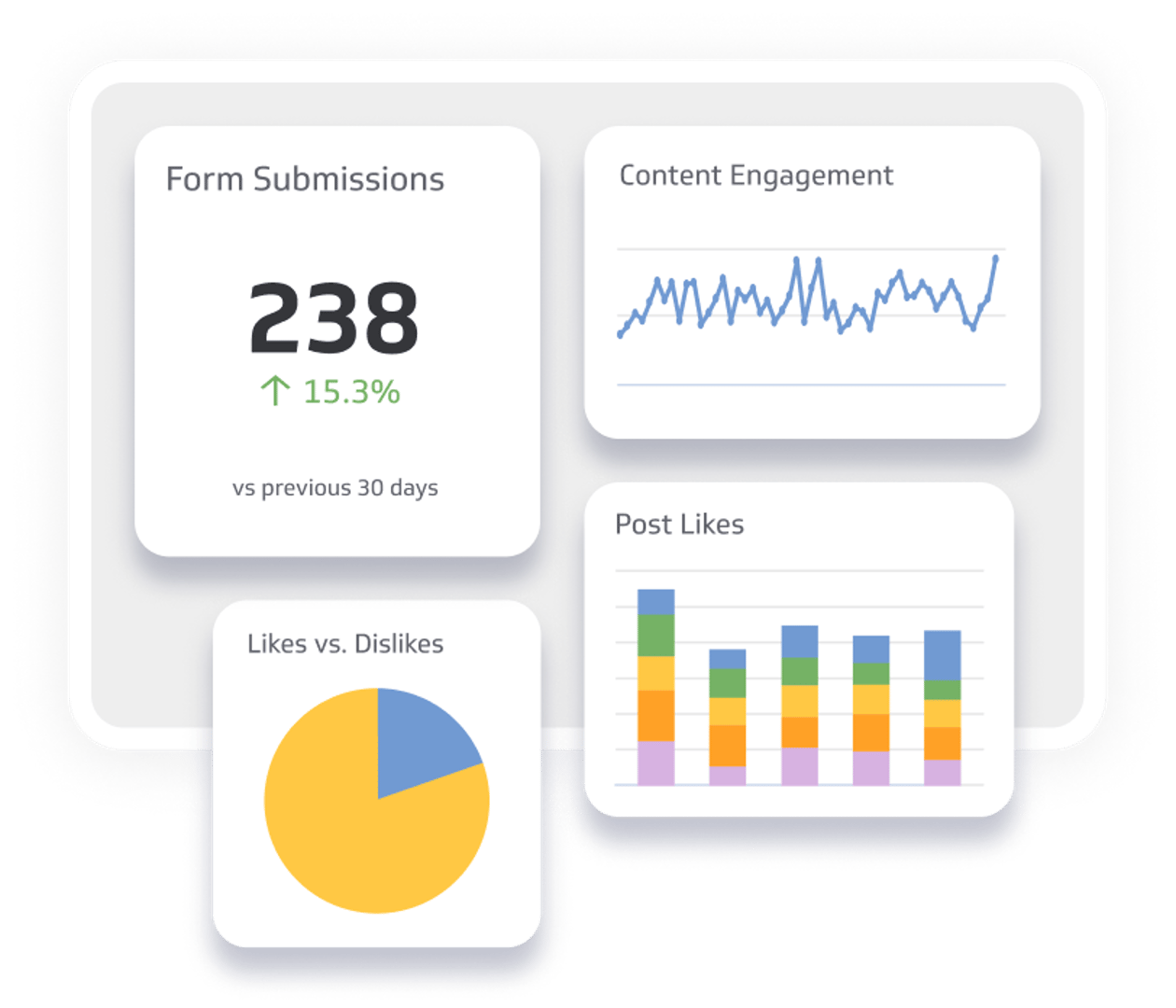
Create custom dashboards for you and your team.
Get started with KlipsWhat's your momentum metric?
These examples reflect how my team operates. Your momentum metrics should reflect how yours does. Just as KPIs should be carefully defined for your organization, so should the metrics that tell you whether the work is actually getting done.
For an early-stage marketing team, momentum metrics may be the first thing you can reliably measure. They won't go in a board deck, but they'll tell you whether the marketing engine is running and whether your team has the confidence and consistency to keep it moving.
What's your momentum metric? What's working for your team?
Published 2026-08-24




Most recent
- AUG 11Beyond simple sign-ups: how True Trials and Activation predict growth
- JUL 7Why business leaders miss important trends in their dashboards
- JUN 19The best chart for the job: Visualizing data for non-technical users
- JUN 95 tips to understand (and organize) your restaurant data
- MAY 26Think in Horizons, Not Seconds
- MAY 2010 Cloud BI Dashboard Tools for Small Businesses in 2026