

Get the HR into OKRs
OKRs only work when the right HR practices back them up. This article explains the HR processes that give OKRs life, from goal setting and career development to performance reviews and recognition, and shows how dashboards give every conversation a shared, reliable foundation.

OKR success takes more than just OKRs
Objectives and Key Results (OKRs) only work when the right HR practices back them up. The numbers tell you where you stand; your people practices determine what happens next.
Some leaders assume OKRs are purely about the hard facts: set the objectives, track the key results, done. Getting the facts right matters enormously, but what drives performance is how your organization uses those facts to make decisions and change behaviour.
My tree metaphor can help explain this.
Think of OKRs as the roots that anchor and nurture the tree. HR practices are the rest of the tree: trunk, branches, and foliage, the parts you can actually see. Strong roots are critical, otherwise the tree dies or falls over. But it is the above-ground structure that gathers light, attracts pollinators, and makes the tree useful.
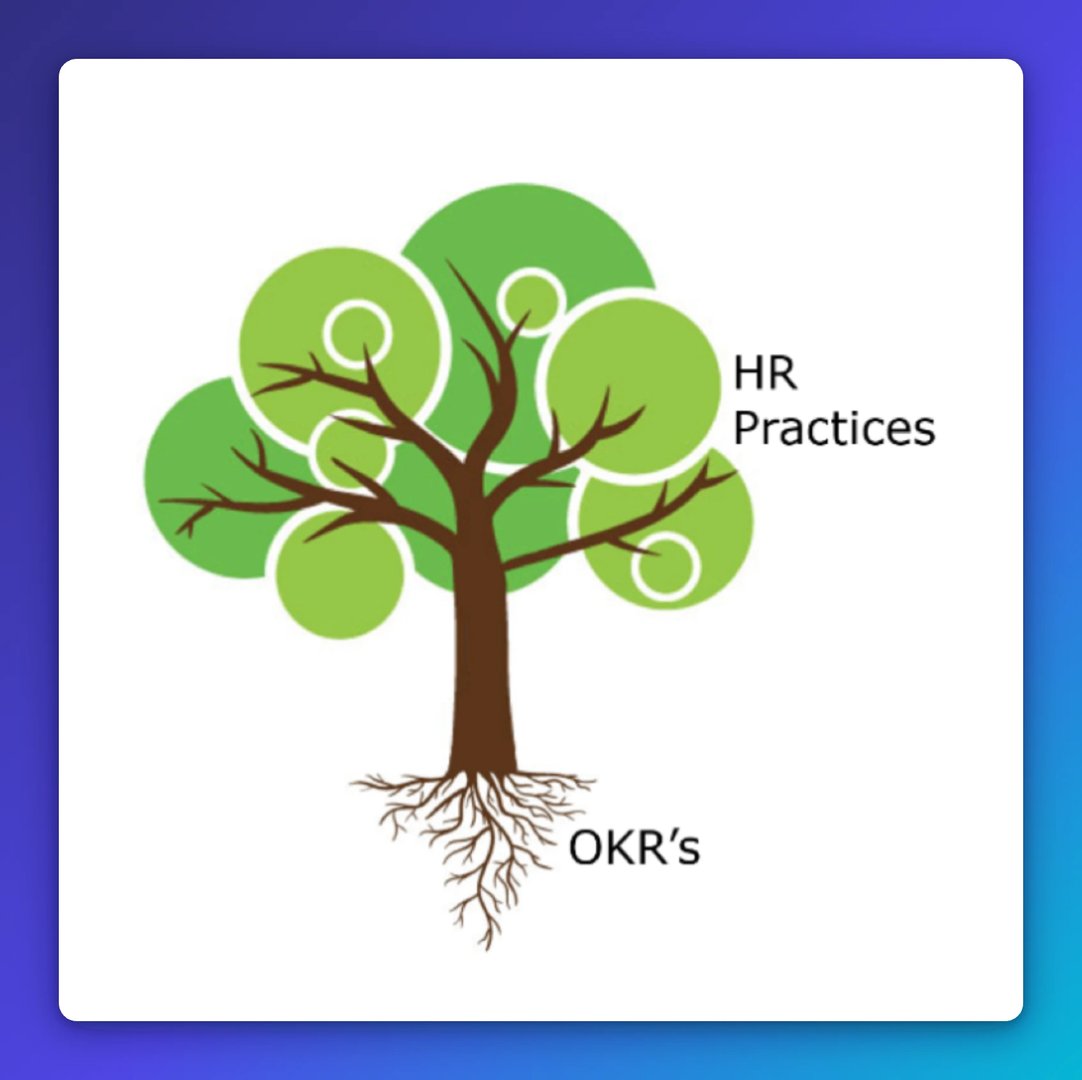
This article focuses on the above-ground part: the HR practices that give your OKRs life.
To learn more about the roots, read Get the HR out of OKRs.
Why HR practices determine whether OKRs stick
The right HR practices create the right behaviours. Successful OKR cultures make performance conversations risk-free, positive, and supportive. Those behaviours become the culture over time.
To make those behaviours consistent, you need explicit tools, like HR dashboards, that surface the right information at the right moment. A dashboard does not replace the conversation; it gives every manager and employee the same reliable numbers to anchor it. Without that shared view, people spend meeting time debating whose spreadsheet is correct instead of deciding what to do next.
The alternative most leaders fall back on is pasting numbers into a chatbot or pulling figures from memory and hoping they are close enough. That is not a system. It is guesswork dressed up as analysis.
What HR is responsible for in an OKR system
HR develops the procedures and practices that everyone else follows. In an OKR context, the processes HR enables include:
-
Peer feedback: structured channels for colleagues to share input across teams
-
Recognition: timely acknowledgement of progress, not just year-end results
-
Coaching: ongoing conversations between managers and employees about performance and direction
-
Skills development: building capability tied to current and future objectives
-
Career development: connecting individual growth to organizational goals
-
Performance reviews: formal checkpoints grounded in data gathered throughout the year
Your OKR dashboards need to enable all of these conversations. And because employee expectations are shifting, what HR must provide is shifting too.
According to Deloitte, several changes are reshaping performance management:
-
Ratings are being eliminated in favour of coaching, feedback, and agile goal management. OKR dashboards need to support frequent goal revision, not just annual snapshots.
-
Pay and performance are being decoupled to reduce bias. Salary decisions are moving toward impact, market position, and teamwork. Dashboards need to provide auditable facts that support fair reward systems.
-
Goal-setting frequency is increasing. Real-time dashboards are no longer a nice-to-have; they are the infrastructure for modern performance management.
-
Annual reviews are giving way to continuous feedback. Organizations are connecting individual objectives to business strategy at every level, which means dashboards need to be accessible anywhere, at any time.
-
Team performance is outweighing individual performance. Dashboards need to aggregate up and cascade down so leaders can see performance at any level of the organization.
What HR dashboards need to support
Goal setting
Your goal-setting process determines whether OKRs create alignment or just paperwork. Leading organizations set goals quarterly, update them frequently, and make them visible across all levels.
Best practice includes collaborative goal-setting between managers and employees, active tracking through OKR dashboards, and regular revision as company priorities shift. When goals are jointly created, accountability and buy-in follow. Quarterly reviews that feed directly into the next period's goals keep the system alive.
Create custom dashboards for you and your team.
Get started with KlipsCareer development
This conversation gets deprioritized more than any other, usually because urgent business demands crowd it out. Including at least one career development goal in every employee's quarterly OKR cycle keeps it from disappearing entirely.
Rather than a single annual planning session, managers and employees should discuss development openly during regular check-ins. The goal is to build plans that use each person's strengths and reflect where they want to go. Ongoing feedback makes those plans real rather than aspirational.
Performance reviews
Continuous feedback through OKR dashboards reduces the burden of formal reviews. Managers who have been checking in regularly arrive at review time with evidence, not impressions.
If you still hold formal reviews, shift to a quarterly or six-month cadence rather than annual. A few things worth keeping in mind:
-
Business does not run on annual cycles anymore, and your performance process should not either
-
Annual reviews are expensive to prepare and often produce subjective appraisals instead of actionable feedback
-
Frequent check-ins produce better data than a single high-stakes conversation
-
Formal reviews should use the same dashboards you use for weekly progress conversations, not a separate set of numbers assembled for the occasion
Ongoing progress updates
Managers and employees need a regular rhythm for reviewing progress toward jointly set goals. Weekly is the right frequency for most teams. These conversations should celebrate milestones and surface obstacles before they become blockers.
Your OKR dashboards need to capture both the agreed targets and actual performance, so neither party is working from a different version of the truth.
Two-way feedback
Timely coaching from manager to employee gives people the chance to course-correct while it still matters. These conversations should also run in the other direction: employees need a clear channel to give feedback to their managers.
Leading organizations use conversation-based coaching models that draw on multiple sources: peers, team members, and upward feedback. Your OKR dashboards should bring these information sources into a single view so conversations are grounded in data, not perception.
Praise and recognition
Recognition keeps employee engagement high and people focused on completing objectives. Acknowledging a recent win, large or small, signals that the contribution mattered to the organization's overall progress.
Recognition tied to dashboard data is more credible than recognition tied to a manager's memory. When someone can see exactly what they achieved and hear it acknowledged in the same breath, the feedback lands.
Training managers
Your managers are already stretched. Asking them to provide real-time, ongoing feedback to every employee without tools or training is not realistic.
Training needs to answer three questions: How do you create effective OKRs? How do you report targets and progress accurately? How do you use the dashboard to enable the right conversations? A structured approach ensures the dashboards and the human conversations reinforce each other rather than working in parallel.
Create custom dashboards for you and your team.
Get started with KlipsWhat this looks like in practice
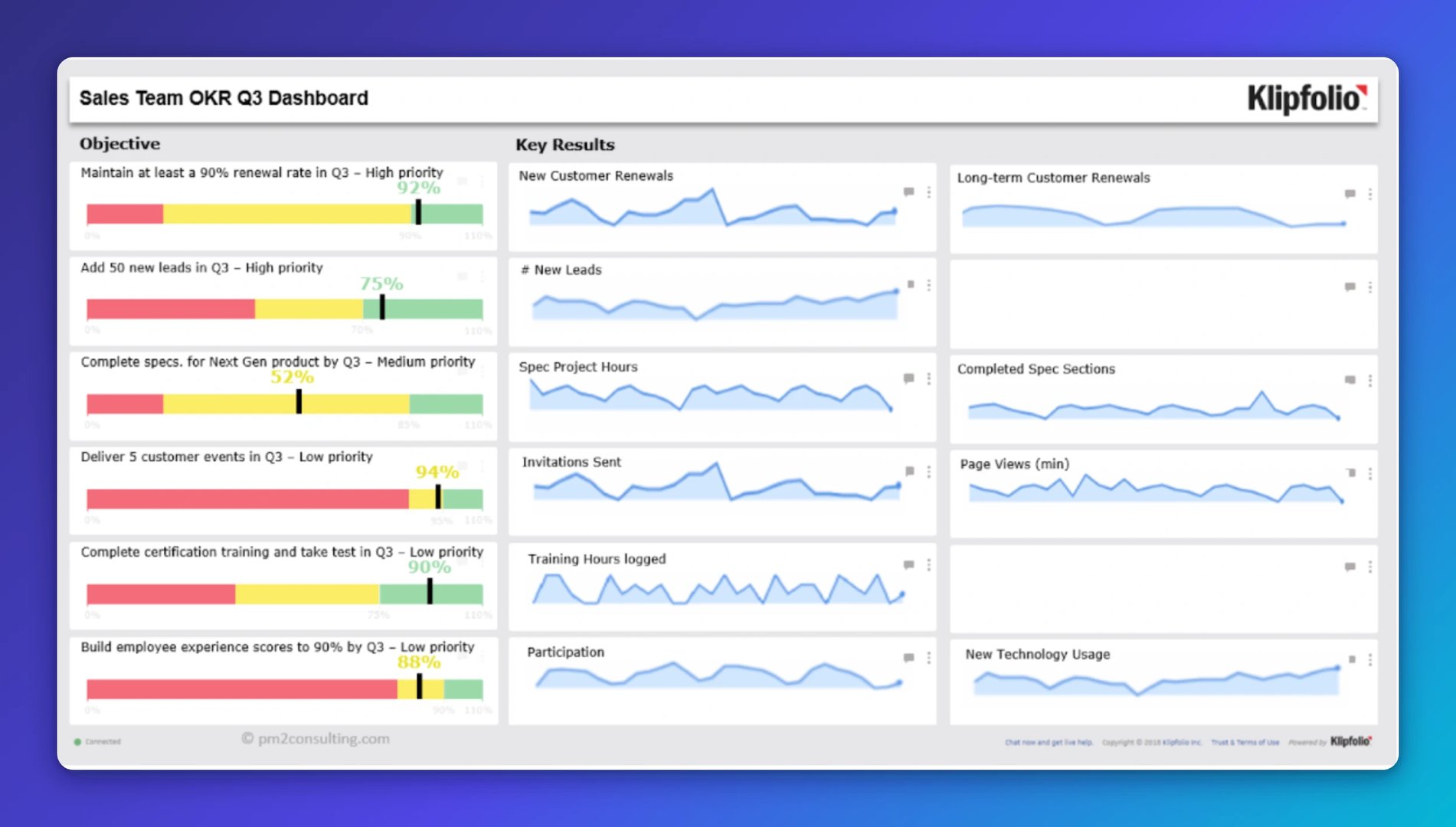
This is a simple OKR dashboard built for a client that already had healthy HR practices. They did not need a new performance system; they needed a single place to capture departmental, team, and individual performance so every conversation started from the same numbers.
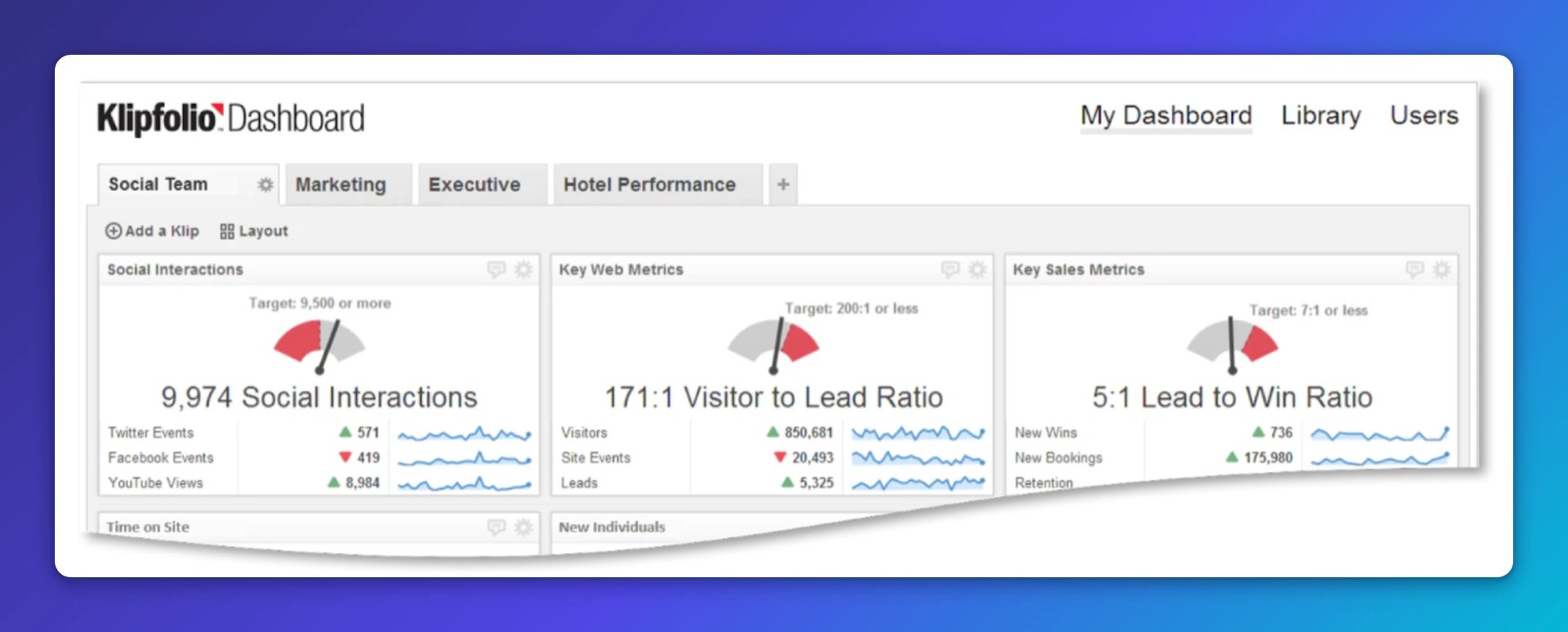
In this case, the client had multiple Key Result categories with several metrics within each. That is not what John Doerr would prescribe, but it reflects what most organizations actually look like.
The next step is capturing those ongoing conversations directly on your team's dashboard. In practice, clients do this one of two ways: a simple process with Google Sheets, or by connecting existing tools like Jira, Salesforce, or Slack where those comments already live.
The goal is not a perfect system on day one. It is getting your team to the point where the dashboard is the single source of truth, and every performance conversation starts there.
Read Get the HR out of OKRs next.
Published 2026-08-23
More in HR

12 important sales enablement metrics you shouldn't miss

What you should measure in employee performance reviews
Are your key results undermining your objectives?

Employee retention metrics: The 5 metrics you should be measuring

5 Hacks to Writing "Measure What Matters" OKRs
Three Essential Metrics for Studying HR Specialists' Success
Most recent
- AUG 11Beyond simple sign-ups: how True Trials and Activation predict growth
- JUL 7Why business leaders miss important trends in their dashboards
- JUN 19The best chart for the job: Visualizing data for non-technical users
- JUN 95 tips to understand (and organize) your restaurant data
- MAY 26Think in Horizons, Not Seconds
- MAY 2010 Cloud BI Dashboard Tools for Small Businesses in 2026