

Are you spending too much money acquiring new customers?
Knowing whether you're spending the right amount to acquire new customers is one of the most important questions a business leader can answer. The LTV:CAC ratio compares what a customer is worth over their lifetime against what it cost to win them. This article walks through how to calculate both figures and what a healthy ratio looks like.

Knowing whether you're spending the right amount to acquire new customers is one of the most important questions a business leader can answer. Get it wrong in either direction and you're either bleeding cash or leaving growth on the table.
The metric that answers this question is the LTV:CAC ratio: the relationship between the lifetime value of a customer (LTV) and the cost of acquiring that customer (CAC). It sounds like jargon, but the underlying idea is straightforward. You're comparing what a customer is worth to you over their entire relationship with your business against what you spent to win them in the first place.
A business that doesn't track this ratio is flying blind. You can't make confident decisions about your sales and marketing spend without it.
Why this ratio matters for subscription businesses
For any business that runs on recurring revenue, this ratio is especially critical. Customers don't stay forever, which means you're always in the market for new ones.
If you spend too much acquiring customers, it eats into your margins. If you spend too little, you're missing growth you could have had. The LTV:CAC ratio tells you exactly where you stand, so you're not guessing.
How to calculate customer lifetime value (LTV)
Your first step is understanding how long the average customer stays before they cancel.
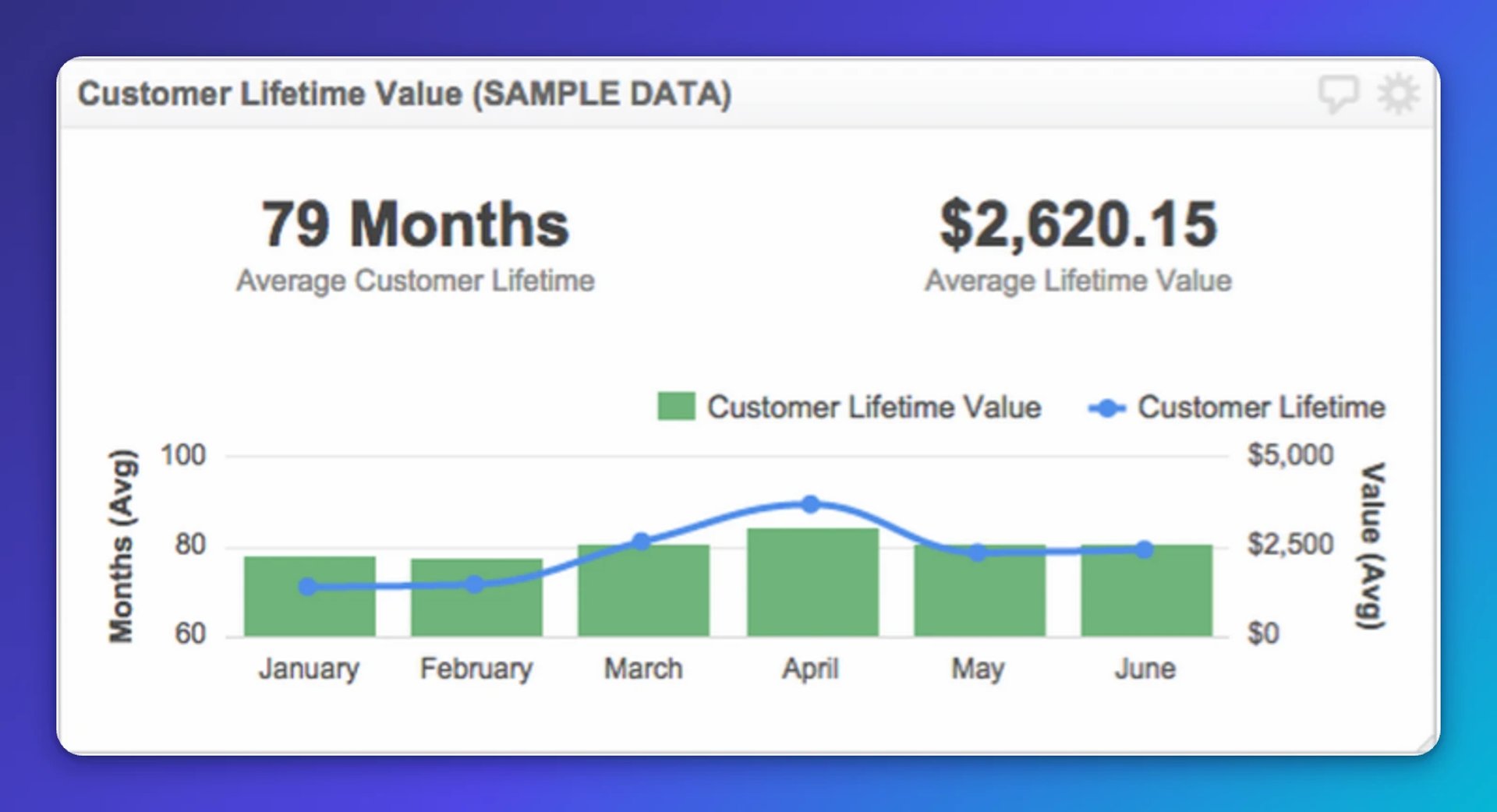
Start with your churn rate: the percentage of customers who cancel in a given month. If you have 1,000 customers and 20 cancel each month, your monthly churn rate is 2%. Inverting that figure (1 / Monthly Churn) gives you the average number of months a customer stays. At 2% monthly churn, that's 50 months.
You also need your Gross Margin percentage and your average monthly subscription revenue per customer. Put those together:
Lifetime Value = Gross Margin % × (1 / Monthly Churn) × Avg. Monthly Subscription Revenue per Customer
Using a gross margin of 75%, monthly churn of 2%, and average monthly revenue of $40 per customer:
75% × (1 / 2%) × $40 = $1,500 LTV
That $1,500 is what the average customer is worth to your business over their lifetime with you. That's the number you need to know before you can make a confident call on how much to spend winning them.
Add this Klip to your Dashboard
How to calculate customer acquisition cost (CAC)
CAC is your total sales and marketing spend divided by the number of new customers you won in the same period.
Cost to Acquire a Customer = Sales and Marketing Costs / New Customers Won
If you spent $500,000 on sales and marketing in a month and acquired 500 new customers:
$500,000 / 500 = $1,000 CAC
One note: this calculation works cleanly when your sales cycle is short and costs can be tied directly to new customers in the same period. If your cycle is longer, stagger your costs and wins to get a more accurate picture.
Add this Klip to your Dashboard
What a healthy LTV:CAC ratio looks like
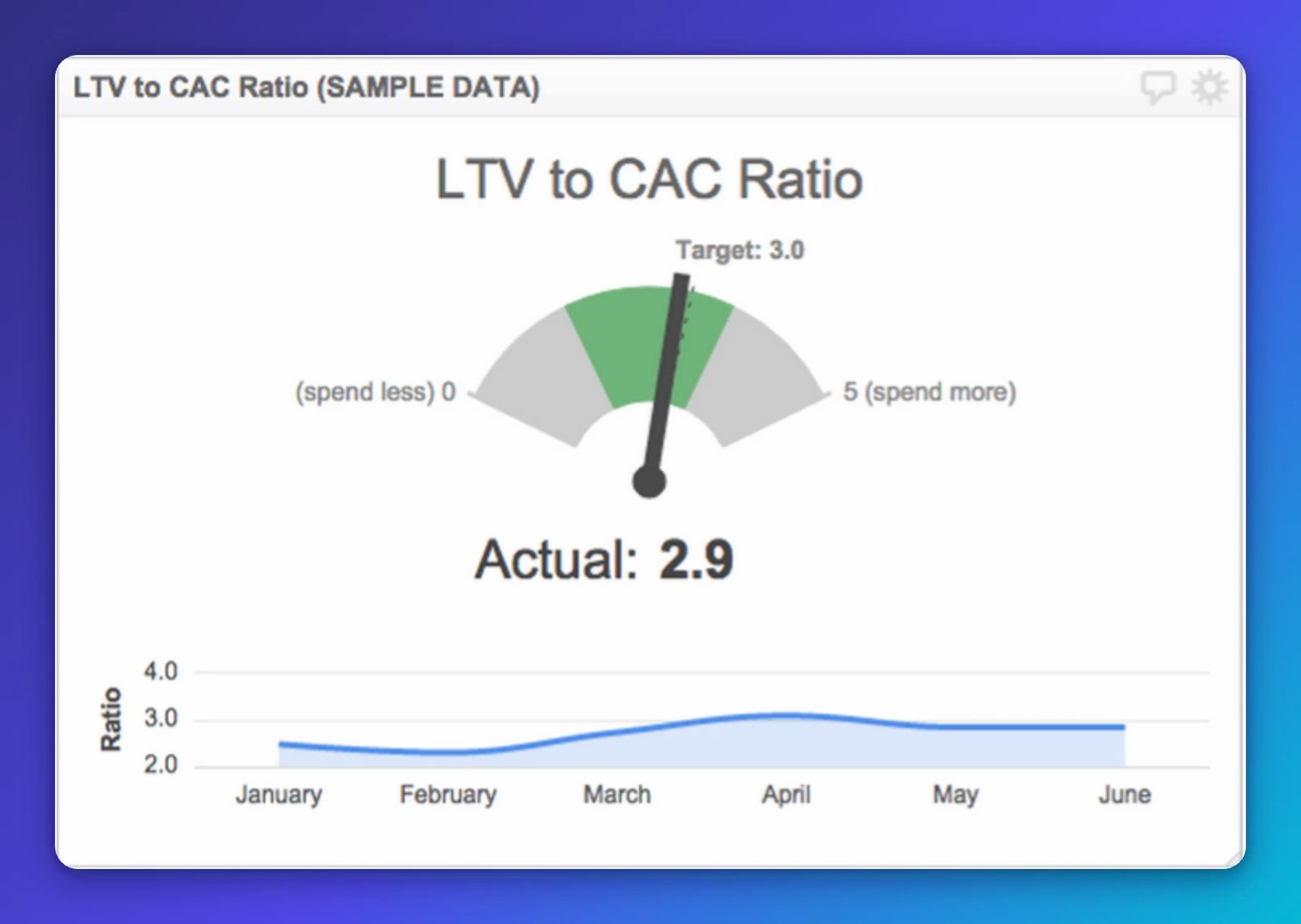
A ratio of 3:1 is the benchmark most businesses aim for. The lifetime value of a customer should be roughly three times what it cost to acquire them.
Using the numbers above: an LTV of $1,500 against a CAC of $1,000 gives you a ratio of 1.5:1. That's too close. You're spending too much to acquire customers relative to what they return.
Here's how to read the ratio:
- Close to 1:1: You're spending too much. Margins are thin and growth is expensive.
- Around 3:1: You're in a healthy range. Acquisition spend is working efficiently.
- 5:1 or higher: You're probably underinvesting. You could be growing faster.
Ideally, you want to recover your acquisition cost within the first 12 months of a customer relationship. In the example above, a $1,500 LTV spread over 50 months means a healthy CAC target sits around $360.
Create custom dashboards for you and your team.
Get started with KlipsKnow your numbers, make better calls
The calculation itself isn't complicated. What matters is having reliable numbers to put into it, and checking them often enough that you catch drift before it becomes a problem.
When you know your LTV:CAC ratio, you stop guessing about your sales and marketing budget. You can see clearly whether to push harder on acquisition, pull back, or shift where you're spending. That's the kind of clarity that lets a lean team make decisions with the same confidence as a much larger one.
Published 2026-08-22




Most recent
- AUG 11Beyond simple sign-ups: how True Trials and Activation predict growth
- JUL 7Why business leaders miss important trends in their dashboards
- JUN 19The best chart for the job: Visualizing data for non-technical users
- JUN 95 tips to understand (and organize) your restaurant data
- MAY 26Think in Horizons, Not Seconds
- MAY 2010 Cloud BI Dashboard Tools for Small Businesses in 2026