

The mistakes companies make when setting KPIs
Avoid the most common KPI mistakes. Learn what to measure, how to keep KPIs specific, actionable, and alive, and how to share results with clear dashboards in Klipfolio Klips.
Key performance indicators (KPIs) help you make better decisions, track progress, and understand what's actually driving results. But only when they're set up correctly.
Most KPI mistakes don't happen because leaders don't care. They happen because the process starts in the wrong place. Here's what to watch for, and how to get it right.
Not knowing what to measure
Clarity about what to measure is the foundation. Without it, everything else falls apart.
HubSpot's Metrics That Matter to Your CEO identifies the most common measurement challenges leaders face:
- Not knowing what to measure in the first place
- Confusion about how metrics shape strategy and day-to-day decisions
- Uncertainty about connecting KPIs to business objectives across departments
- Difficulty synchronizing data from different parts of the business
- Misreading results, especially when they reveal something uncomfortable
HubSpot's advice is worth anchoring to: "Results ultimately stem from the right activities. So working backwards from the end goal like revenue to the front end of the sales process will actually help the salesperson understand the necessary activity to achieve their goal."
Start with the outcome you need to influence. Then work backwards to find the number that tells you whether you're on track.
Setting KPIs that don't fit your business
Many teams skip the hard thinking. They brainstorm a list, look at what others track, and copy KPIs that sound reasonable. The result is a set of metrics that measure activity without connecting to anything that matters for their specific situation.
A KPI that works for a SaaS company at Series B may be useless for a professional services firm managing project margins. Context matters.
Start with your goals, not someone else's dashboard. Then look at the data you already have access to, including:
- Sales patterns and pipeline trends
- Social media KPIs tied to specific campaigns
- Google Analytics 4 metrics aligned to conversion goals
- Feedback from managers, directors, and employees closest to the work
- Competitor performance where benchmarking is meaningful
- Profit margins, cash flow, and customer satisfaction scores
- Internal process efficiency and team capacity
The goal is a short list of metrics that reflect your strategy, not a comprehensive catalog of everything you could measure.
Tracking too many KPIs
More metrics don't mean more clarity. They usually mean less.
In The Tyranny of Metrics (2018), Professor Jerry Muller examines what happens when organizations try to quantify everything and then reward or punish based on the numbers alone. His conclusion: measurement should inform judgement, not replace it.
He writes: "If what is actually measured is a reasonable proxy for what is intended to be measured, and if it is combined with judgment, then measurement can help practitioners to assess their own performance, both for individuals and for organizations. But problems arise when such measures become the criteria used to reward and punish."
Too many KPIs also create noise that makes it harder to spot what's actually changing. A lean team can't act on 40 metrics. Give your people a focused set of indicators, and the room to interpret what they're seeing.
Overlooking metrics unique to your situation
Standard KPIs cover the obvious ground. But some of the most useful signals are specific to how your business actually operates.
Consider tracking things like:
- Marketing initiatives that generated no business, not just the ones that did
- Lead generation effectiveness by channel or campaign type
- Sales cycle length and where deals stall
- Pipeline acceleration and what moves opportunities forward
If a metric is relevant to your goals and named clearly, it belongs in the conversation. You don't need industry precedent to justify tracking something that helps you make a better call.
Leaving employees out of the process

Leaders and managers usually define KPIs. That's appropriate. But the people doing the work often see things that don't show up in a top-down review.
An open process, where team members can flag what they think should be tracked, surfaces blind spots. A frontline employee might identify a bottleneck in their role that no one at the leadership level knows exists. If the metric is sensible and actionable, implement it.
Transparency here also builds trust. When people understand why something is being measured, they engage with the results differently.
Collecting data but not acting on it
This is the most common and most costly mistake. You build the tracking, surface the insights, and then nothing changes.
It happens for understandable reasons: schedules are full, resources are stretched, and the gap between "we have the data" and "someone owns the follow-up" is wider than it looks. But if you track customer satisfaction and don't follow up on what it tells you, the tracking itself becomes a liability.
The fix is straightforward: scale back to a set of reports your team can actually use. Assign a clear owner to each KPI. Make the follow-up part of the rhythm, not an afterthought.
Create custom dashboards for you and your team.
Get started with KlipsWhat your KPIs should tell you
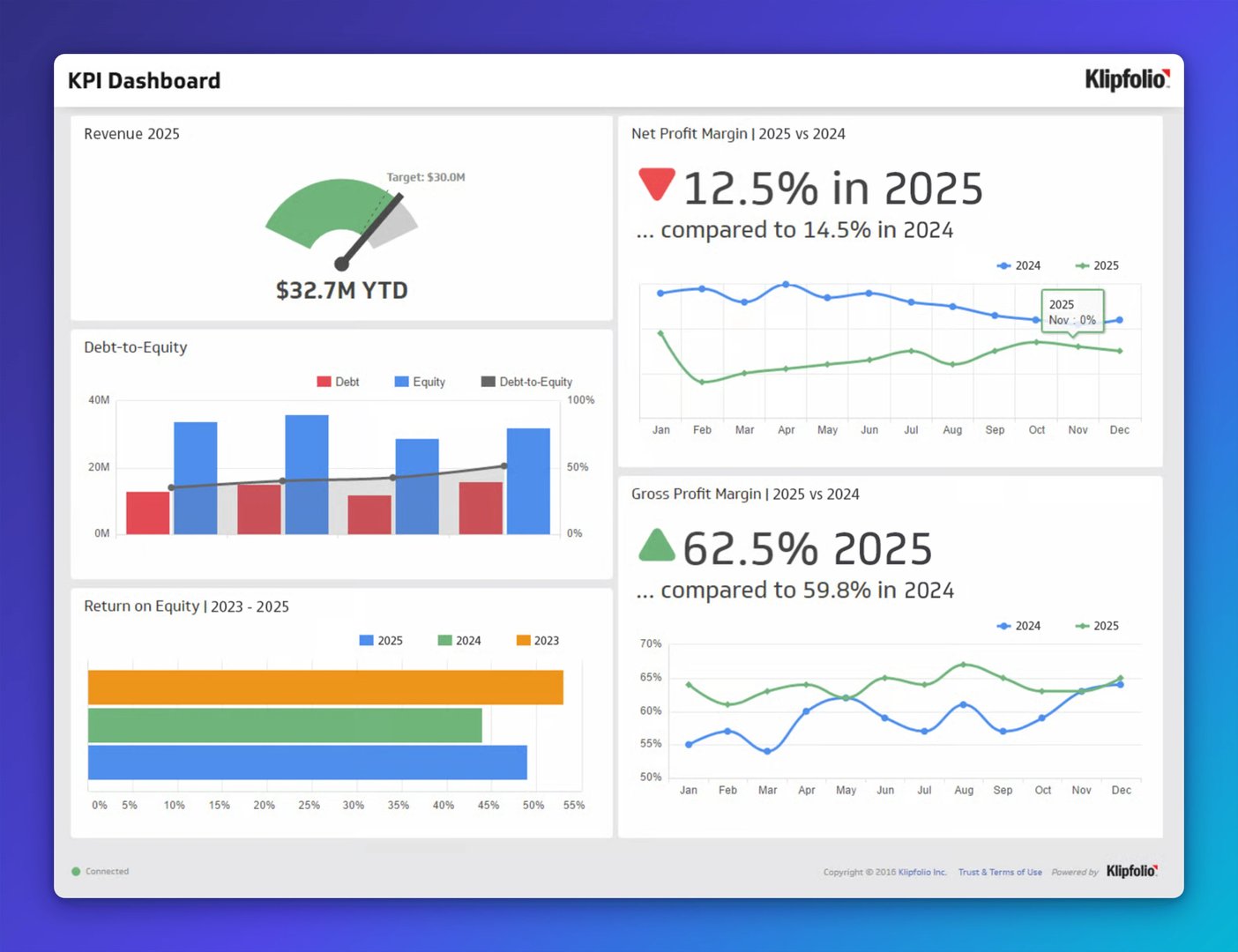
A well-set KPI answers three questions: What's happening? Why does it matter? What do we do next?
Your KPIs should connect directly to your:
- Objectives and the outcomes you're accountable for
- Goals at the team and company level
- Sales forecasts and financial targets
At the end of each KPI period, don't just look at the numbers. Ask what the data is telling you and what action it calls for. Add qualitative context where the numbers alone don't explain the story.
KPIs aren't permanent. Review them quarterly. Drop the ones that no longer reflect your priorities. Refine the ones that do.
With Klipfolio Klips, you can bring your KPIs into a real-time KPI dashboard and share consistent, on-brand reports with your team, so everyone is working from the same numbers without anyone having to chase them down.
Published 2026-08-23
More in Best Practices
Business Metrics vs. KPIs: What’s the Difference?

The 5 most important SEO KPIs for digital marketing success
What is a KPI, metric, or measure?

What are the best inbound marketing KPIs?
Why every digital marketer needs to learn how to deploy marketing technology

Top 10 Marketing Dashboard Ideas for Tech Companies
Most recent
- AUG 11Beyond simple sign-ups: how True Trials and Activation predict growth
- JUL 7Why business leaders miss important trends in their dashboards
- JUN 19The best chart for the job: Visualizing data for non-technical users
- JUN 95 tips to understand (and organize) your restaurant data
- MAY 26Think in Horizons, Not Seconds
- MAY 2010 Cloud BI Dashboard Tools for Small Businesses in 2026