

How to write KPIs in 4 steps
KPIs measure ongoing performance and give you and your team a clear picture of how the business, or a specific department, is tracking against its goals. Follow these four steps to write KPIs that are clear, measurable, and worth acting on: write a clear objective, share with stakeholders, review consistently, and build for action.

KPI stands for key performance indicator, a core tool for making confident business decisions. KPIs measure ongoing performance and give you and your team a clear picture of how the business, or a specific department, is tracking against its goals.
You have a strategy. You have goals. Now you need KPIs that tell you whether you're actually getting there, and what to do when you're not.
4 steps to write KPIs for your company (with examples)
KPIs only work when they're built around your situation. A generic KPI is just a number. A well-written KPI tells you what to do next. Follow these four steps to write KPIs that are clear, measurable, and worth acting on.
1. Write a clear objective for your KPI
Your KPI needs to connect to a real business objective. Without that connection, you're tracking a number that doesn't tell you anything worth knowing.
A KPI should tie directly to your strategic goals and reflect the progress you need to make to achieve them. That's what separates a useful signal from noise.
For example, say the company wants to increase revenue by 10% this quarter. You're on the marketing team, so you look at that company-wide goal and set a KPI for your team: increase marketing qualified leads (MQLs) by 15% this quarter. Qualified leads mean potential revenue, so the connection is direct.
2. Share your KPI with stakeholders
KPIs are a form of communication. They should be succinct, clear, and relevant. Share them with the people who need to know: give context, explain what you're measuring, and explain why it matters.
When information is withheld, teams pull in different directions. Share your KPIs, listen for feedback, and refine how you communicate your goals. A KPI that inspires action is a KPI worth having.
Using the MQL example: share that KPI with sales. An increase in MQLs will lead to more sales qualified leads (SQLs) and more wins. Teams that feel the impact of your KPI should know about it before it happens, not after. That shared visibility is what keeps everyone moving in the same direction.
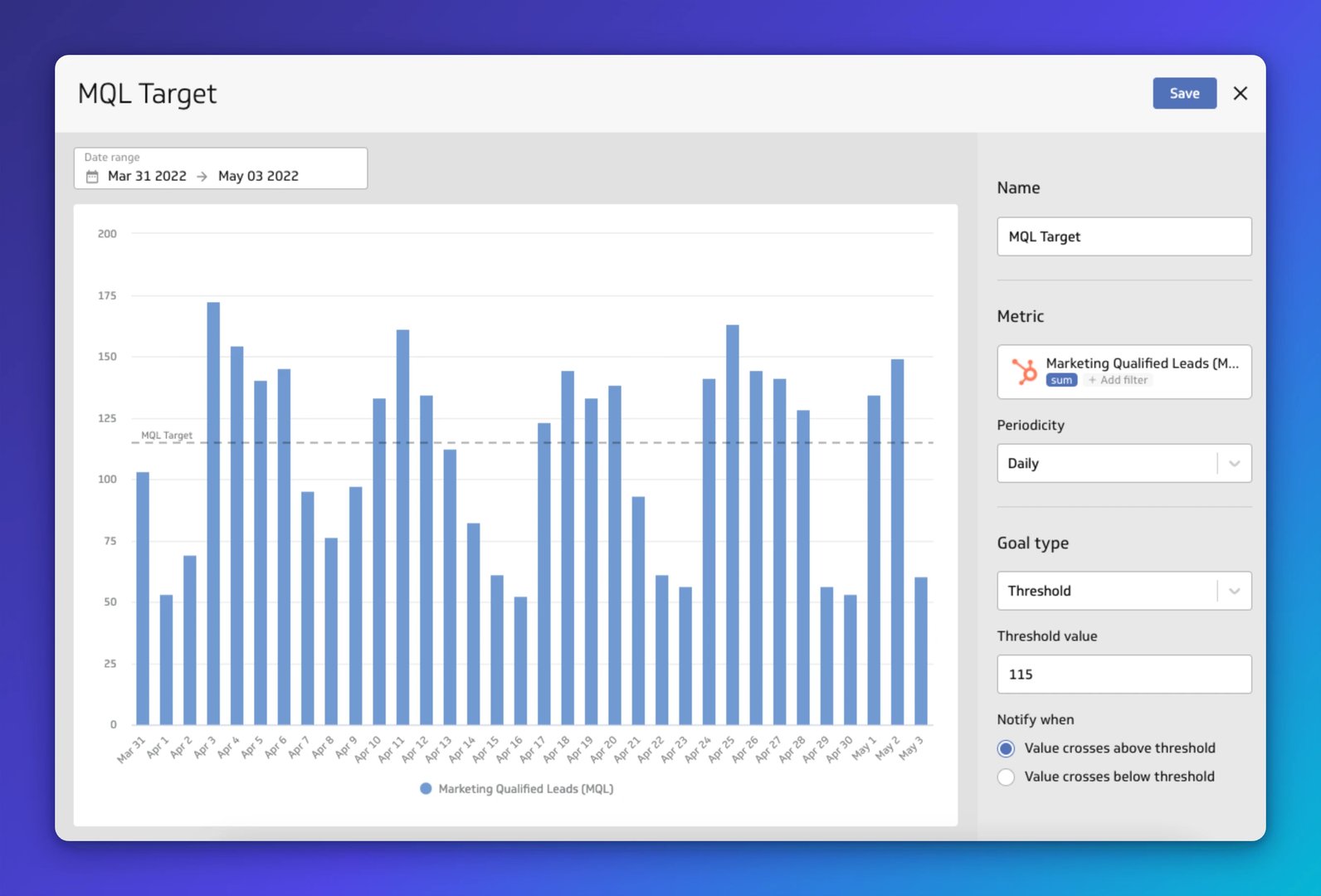
3. Review your KPIs on a consistent basis
Review KPIs from two angles: how you're tracking against the KPI, and whether the KPI itself is still the right one to track.
Look at your business metrics regularly. If progress has stalled, the KPI may have missed the mark and it's time to iterate. That's not failure. That's how good KPIs get refined.
For the MQL example, track MQL to SQL conversion rate and lead to win rate alongside raw MQL volume. Ask yourself: Are the numbers where they need to be? Is progress steady? If MQLs are trending down compared to previous months, you're likely off track, and you need to know that now, not at quarter end. The goal isn't to check a dashboard; it's to catch a problem early enough to do something about it.
Create custom dashboards for you and your team.
Get started with Klips4. Create actionable KPIs
A KPI that sits in a spreadsheet or gets pasted into a slide deck isn't driving anything. The goal is a number you trust, reviewed on a rhythm, connected to a decision. Here are five ways to make KPIs something you act on, not just report on.
Review business objectives regularly: KPIs aren't static. They should evolve as your goals evolve, and your actions should shift with them.
Analyse current performance: Set achievable targets by looking at historical data. Use Klipfolio to establish a baseline and see what you've actually accomplished in the past, rather than guessing or piecing it together from memory.
Set short and long-term targets: Start with a quarterly or annual goal, then work backward to identify the milestones you need to hit along the way. This gives you room to course-correct before it's too late.
Review targets with your team: Keep everyone in the loop. A KPI only drives results when the people responsible for it understand what they're working toward.
Check in and readjust: Make it a habit. KPIs aren't set-and-forget. Regular check-ins on both performance and relevance get easier the more consistent you are.
Here is what your KPI looks like in practice, using the MQL example.
| Question | Answer |
|---|---|
| What is your desired outcome? | Increase MQLs by 15% this quarter |
| Why does this outcome matter? | More MQLs means a higher ratio of sales qualified leads and wins |
| How are you going to measure progress? | MQL volume based on lead scoring in your CRM |
| How can you influence the outcome? | Improve content for funnel stages, run an email nurture campaign, and develop sales collateral |
| Who is responsible for the business outcome? | Marketing team |
| How will you know you've achieved your outcome? | MQL volume will have increased by 15% |
| How often will you review progress? | Weekly |
Four steps: a clear objective, shared with the right people, reviewed consistently, and built to drive action. When your KPIs work this way, you spend less time figuring out where things stand and more time deciding what to do about it.
Published 2026-08-23



Most recent
- AUG 11Beyond simple sign-ups: how True Trials and Activation predict growth
- JUL 7Why business leaders miss important trends in their dashboards
- JUN 19The best chart for the job: Visualizing data for non-technical users
- JUN 95 tips to understand (and organize) your restaurant data
- MAY 26Think in Horizons, Not Seconds
- MAY 2010 Cloud BI Dashboard Tools for Small Businesses in 2026